
The Shift from Scale to Precision
February 2026
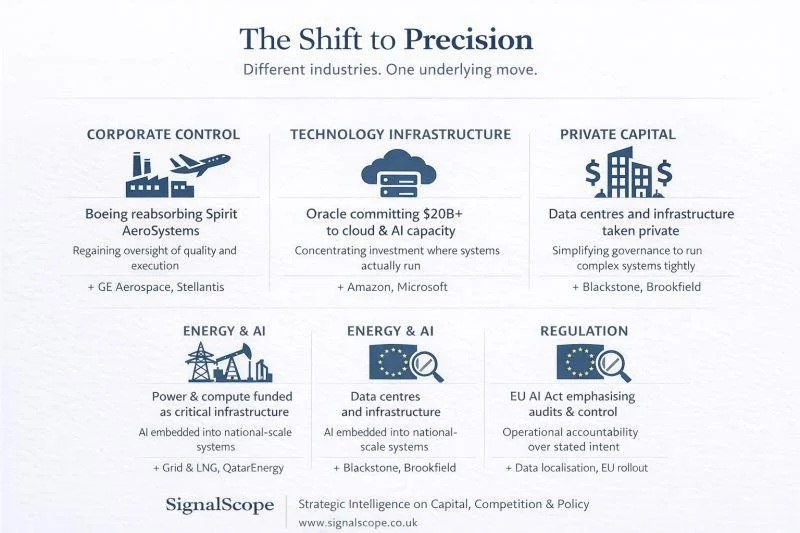
For decades, competitive advantage in banking was built on scale.
Larger balance sheets, broader customer bases and global distribution networks created durable market positions. Efficiency improved as institutions grew, and the ability to process higher volumes at lower cost became a central source of strength.
That model is now beginning to evolve.
Across financial services, a series of developments suggest a shift toward something different: precision.
Rather than simply expanding capacity, institutions are increasingly investing in systems that allow them to understand and manage complex operational environments in real time. Risk, compliance, market exposure and transaction flows are being monitored and analysed with increasing granularity.
The competitive question is gradually changing.
It is no longer only about how much activity an institution can process. Increasingly it is about how precisely it can understand, control and respond to that activity.
This shift is visible across several areas of banking infrastructure.
Artificial intelligence is being embedded within core operational workflows, enabling more sophisticated detection of anomalies in payments, trading and customer behaviour. Real-time monitoring systems are being strengthened to manage fraud, market risk and operational resilience as transaction speeds accelerate.
At the same time, regulatory expectations around governance and transparency are increasing. Supervisors are placing greater emphasis on explainability, auditability and oversight, particularly as automation becomes more deeply embedded within financial institutions.
These pressures are pushing banks to develop more sophisticated internal control systems — infrastructure capable of monitoring activity continuously rather than retrospectively.
Precision, in this context, becomes a strategic capability.
Institutions that can observe, interpret and manage complex systems in real time may gain an advantage not simply in compliance or risk management, but in operational performance, capital allocation and strategic agility.
Scale still matters.
But scale without precision is becoming harder to sustain in an environment defined by rapid technological change, real-time financial flows and increasingly demanding regulatory frameworks.
The institutions that succeed in this environment may be those able to combine the reach of scale with the discipline of precision.