
The Banking Control Layer
February 2026
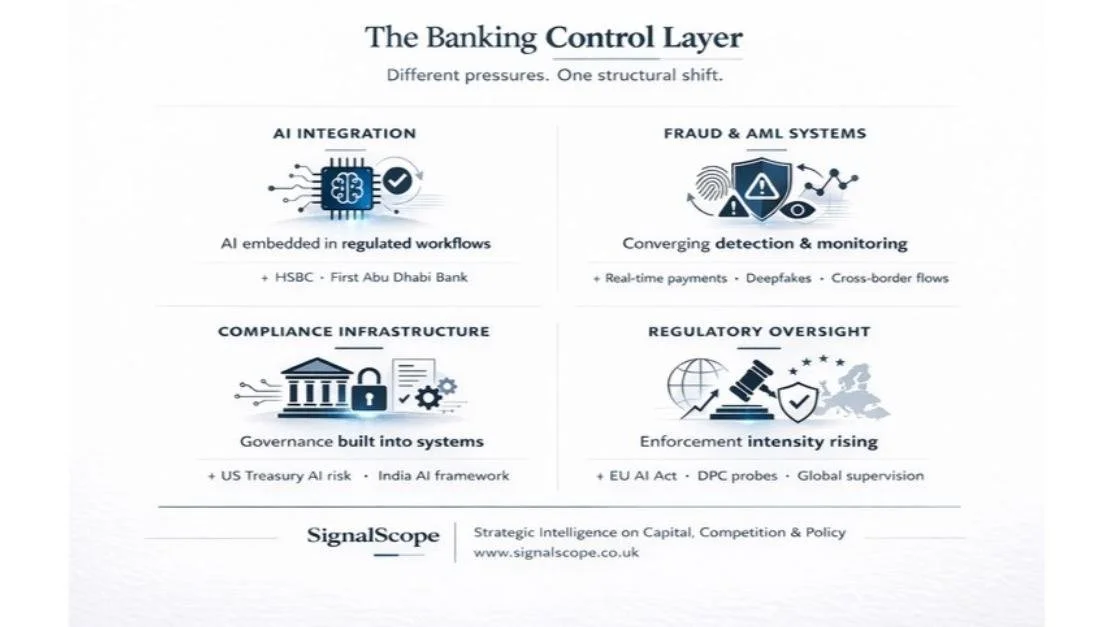
In 2026, the competitive edge in banking may sit with whoever builds the strongest control layer.
Financial institutions are embedding artificial intelligence into core workflows, accelerating real-time payments and expanding digital asset infrastructure.
At the same time, regulatory scrutiny is intensifying.
Systems are getting faster. Oversight is getting deeper.
That intersection is beginning to reshape capital allocation, enterprise architecture and strategy across the sector.
Several recent developments illustrate the direction of travel.
HSBC has partnered with Mistral to deploy frontier-grade AI directly into regulated workflows — signalling a move beyond experimentation toward operational integration. First Abu Dhabi Bank has embedded agentic AI into production systems, indicating that automated decision-making is now operating inside revenue-critical processes.
Capital is also flowing into firms building compliance-focused AI infrastructure. Companies such as AnChain.AI are positioning themselves as part of the structural architecture supporting financial institutions rather than discretionary technology investments.
Meanwhile, Circle continues to expand the role of regulated stablecoins within institutional trading and settlement infrastructure. Citadel Securities has also been exploring interoperability partnerships with LayerZero, reflecting growing attention to the plumbing of digital financial markets.
Taken together, these developments suggest that infrastructure once considered experimental is becoming institutional.
Artificial intelligence is moving deeper into operational systems. Digital asset rails are beginning to integrate with traditional financial infrastructure. Compliance technology is becoming a core layer of enterprise architecture.
At the same time, supervisors are strengthening oversight.
The US Treasury has launched AI cybersecurity and risk-management resources specifically tailored to financial institutions. India has introduced its first comprehensive framework for governing artificial intelligence. Ireland’s data protection authority has begun examining the risks associated with deepfake technologies and generative systems.
Across jurisdictions, regulators are signalling that AI, digital assets and automated financial systems will increasingly sit within formal supervisory frameworks.
The message is clear: innovation is embedding itself deeper into regulated environments at the very moment oversight is becoming more muscular.
Forward-looking industry reports are beginning to converge around the same theme.
ProSight’s CRO Outlook 2026 places technology and cyber risk at the top of executive agendas. BDO’s Fintech Predictions highlight that agentic AI will only gain credibility where decision-making processes are explainable and auditable. Capgemini’s World Payments Report points to structural weaknesses in siloed fraud monitoring, while EY’s regulatory outlook highlights growing fragmentation in oversight across AI, digital assets and payments.
Across strategy, risk and policy commentary, the pattern is consistent.
Capabilities are expanding. Expectations are rising. Tolerance for opaque systems is shrinking.
In this environment, the institutions best positioned for the next phase of competition may not be those launching the most features.
They may be those able to demonstrate, in real time, how decisions are made, how risks are monitored and where accountability sits.
Control layers rarely generate headlines.
They rarely feature prominently in earnings calls.
But they shape resilience, regulatory standing and long-term competitive durability.
Banking is not retreating from innovation.
It is internalising it.
Artificial intelligence is moving inside compliance frameworks. Fraud detection is converging with AML intelligence. Settlement infrastructure is evolving under supervisory pressure. Governance is becoming architectural rather than procedural.
That is what a strengthening control layer looks like.
And it is already visible in capital flows, regulatory posture and enterprise design.
The question is no longer whether automation will accelerate.
It is whether control will scale with it.