
Signals Behind the Emerging Control Layer
March 2026
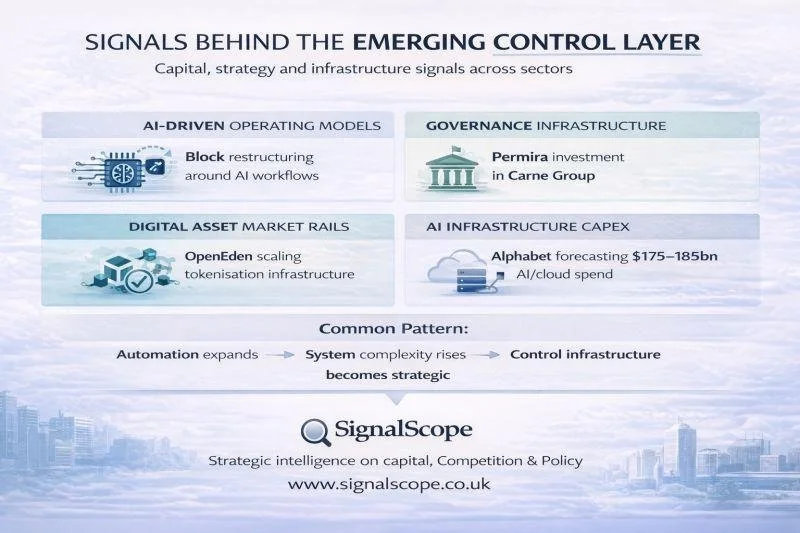
Across financial services, a growing number of developments are pointing to the emergence of a new control layer within banking infrastructure.
Individually, these developments might appear incremental. Taken together, they suggest a deeper shift in how financial institutions are organising technology, governance and operational oversight.
Several recent announcements illustrate this trend.
Oracle has been expanding its financial services infrastructure offering, positioning its cloud and data platforms as foundational systems for regulated financial environments. The focus is not simply on processing power, but on creating environments where data, monitoring and regulatory requirements can be managed together.
In parallel, developments in artificial intelligence are increasingly moving beyond experimentation and into operational banking systems. Financial institutions are beginning to embed AI tools directly within compliance, payments monitoring and risk management processes.
The goal is not only automation, but visibility — the ability to understand system behaviour, detect anomalies and maintain oversight as complexity increases.
Digital financial infrastructure is also evolving.
Stablecoins and blockchain-based settlement systems are gradually becoming embedded within institutional market infrastructure. These systems introduce new efficiencies but also require enhanced monitoring frameworks capable of managing both traditional financial risks and new forms of technological exposure.
At the same time, regulators are signalling that they expect governance to keep pace with these developments.
Supervisory authorities across multiple jurisdictions are increasing scrutiny of AI systems, data management practices and digital financial infrastructure. The emphasis is increasingly on explainability, transparency and the ability to audit automated systems.
This combination of technological change and regulatory pressure is pushing banks toward a more integrated approach to oversight.
Rather than treating compliance, risk management and operational monitoring as separate functions, institutions are beginning to build systems that link these capabilities together.
That integration is what forms the emerging control layer.
It sits between rapidly accelerating financial activity and the governance structures required to supervise it.
As financial systems become faster and more automated, this layer becomes increasingly important.
It enables institutions to maintain trust, resilience and regulatory alignment even as operational complexity grows.
The development of this infrastructure may not always be visible in headline announcements.
But across technology deployments, regulatory initiatives and capital investment, the signals are becoming clearer.
Banking is entering a phase where competitive advantage will increasingly depend on how effectively institutions can observe, interpret and govern their own systems in real time.