
Strategic Reset in Financial Services
March 2026
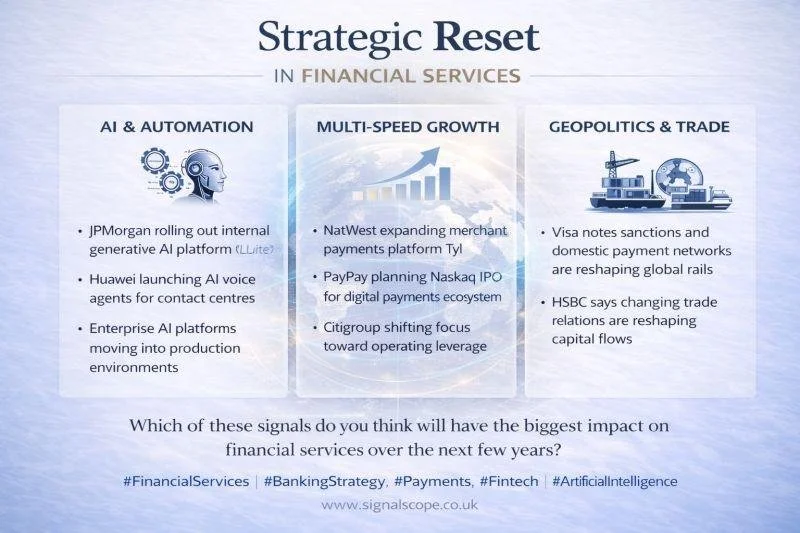
Across financial services, a growing number of developments suggest that the sector may be entering a period of strategic reset.
For much of the past decade, competition in banking has centred on digitisation and customer experience. Institutions focused on expanding digital channels, improving mobile interfaces and increasing transaction speed.
Those priorities remain important.
But a different set of forces is now beginning to shape the next phase of industry evolution.
Artificial intelligence is moving from experimentation into operational banking systems. Real-time payments infrastructure is expanding across markets. Digital asset technologies are gradually integrating with traditional financial architecture. At the same time, regulatory expectations around governance, transparency and operational resilience are increasing.
Together, these forces are beginning to reshape how financial institutions think about infrastructure, risk and competitive advantage.
The challenge facing banks is not simply adopting new technologies.
It is integrating them into highly regulated environments while maintaining trust, oversight and stability.
Several recent developments highlight how institutions are responding.
Banks are embedding AI directly into workflows across compliance, payments monitoring and customer service. Technology firms are positioning cloud and data platforms as foundational infrastructure for regulated financial environments. Meanwhile, digital asset systems such as stablecoins and blockchain-based settlement networks are gradually becoming part of institutional market infrastructure.
At the same time, supervisory authorities are strengthening expectations around governance.
Across multiple jurisdictions, regulators are increasing scrutiny of artificial intelligence, data management and digital financial infrastructure. The emphasis is increasingly on explainability, auditability and the ability to monitor automated decision-making systems.
This convergence of technological acceleration and regulatory tightening is creating a new set of strategic priorities for financial institutions.
Speed alone is no longer sufficient.
Institutions must also ensure that systems remain observable, controllable and accountable.
That requirement is pushing banks to rethink how core infrastructure is designed.
Rather than treating innovation and governance as separate domains, many institutions are beginning to integrate them directly into enterprise architecture. Monitoring systems, compliance processes and operational analytics are increasingly being embedded alongside automation technologies.
The result is a shift toward infrastructure that can support both rapid innovation and continuous oversight.
This transition may not always be visible in public announcements.
But across capital investment, technology deployment and regulatory posture, the signals are becoming clearer.
Financial services are entering a phase where resilience, transparency and operational control will sit alongside speed and scale as defining characteristics of competitive advantage.
For banks navigating this transition, the challenge will be building systems capable of supporting both.